
COSMIC CANVAS: EXOPLANETS PROGRAM GUIDE
Introduction
Exploring the Universe through Art and Astronomy
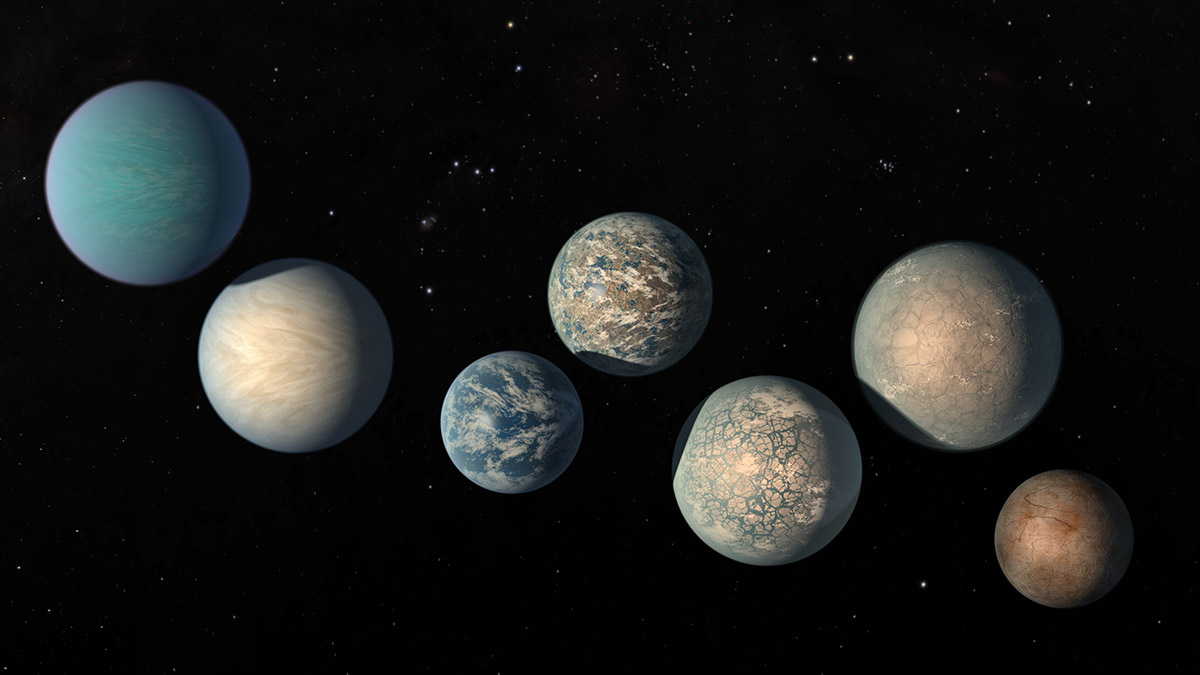 The Cosmic Canvas: Exoplanets Program Guide invites adult-youth pairs to discover planets beyond our solar system — called exoplanets — through creative, hands-on activities that blend art and science. The guide can be run as a full 90-minute program, or as standalone activities – including a Warm Up, Explore, and Create! activity. Participants will observe, interpret, and create models like scientists and artists do while learning how scientists study distant worlds.
Activities include:
- Observe, Think, Wonder or Cosmic Stories — Craft creative interpretations of astronomical images, illustrations, and/or artworks to spark curiosity and practice observation and communication skills.
- Draw from the Data Illustrating the TRAPPIST-1 Exoplanets — Build a scale model of the TRAPPIST-1 system of exoplanets and explore how scientists and artists use real data to visualize distant worlds.
- Make Your Own Exoplanet Model — Describe an exoplanet and bring it to life through poster artwork or paper-mache!
The guide is designed for facilitators of all backgrounds and includes science background information, helpful links, and tips for adapting activities – no science expertise needed.
Astronomy and the Arts: How are they connected?
Callout“The link between art and science for me is my love of color and my love of light.”
-- Dr. Nia Imara (astrophysicist and artist)End callout
In astronomy, the process of scientific inquiry mirrors the creative journey of art-making in many ways. Just as artists observe, interpret, and reflect the world through music, painting, sculpture, and writing, scientists observe the cosmos, interpret data, and create models to understand its many mysteries. Artistic expression, scientific illustration, and modeling play pivotal roles in exploring the universe and conveying ideas, particularly when faced with the unknowns of the vast and challenging-to-observe universe.
In this program guide, participants will practice skills used in both science and art-making while learning about exoplanets.
How to Use This Program Guide
This guide enables facilitators to lead an approximately 90-minute program. This guide is structured in three sequential sections, each approximately 30 minutes in length:
- Warm up: Participants are introduced to and practice skills used in both art and science. We recommend choosing one of the two warm-up activities to lead.
- Explore: Participants engage with scientific topics and discoveries about exoplanet research.
- Create!: Participants apply the concepts and skills learned/practiced earlier in the program to explain and communicate new ideas through art-making.
Accordions
-
- Practice scientific thinking
- Cultivate a sense of STEM identity
- Learn about the process of science and exoplanets
- Increase interest in astronomy
- Explore the connections between art and science
-
These activities were designed for youth-adult pairs to do together. The content was developed for youth around middle school age to engage with alongside a parent, grandparent, guardian, or other trusted adult. However, audience adjustments are welcome, as detailed in some of the Tips and Adaptations sections.
-
We have included a section with a few possible adjustments for different audiences or different formats for each activity, but all activities should be adjusted as is most appropriate for your particular audience.
While the Warm up, Explore, and Create! activities are designed to be done together, you can also lead each activity individually.
-
We’ve included a curated list of Background Science Resources about exoplanets, and we’ve also embedded links to helpful resources throughout this guide. To open links in a new tab (if you are viewing this guide through your web browser):
- On Windows, use Ctrl + Click.
- On a Mac, use Cmd + Click.
- Alternatively, you can Right-Click the link and choose “Open link in a new tab.”
Warm up
The Warm up activities are designed to engage participants and ignite their creativity and curiosity. These activities get each youth-adult pair thinking and discussing ideas just like artists and scientists do, encouraging them to explore the intersection of artistic expression and scientific inquiry.
CalloutNote: There are two Warm up activity options. Choose one option that works best for your group:
End callout
Learning Concepts (for both activities)
Participants will learn that detailed observation, curiosity, analytical thinking, evidence-based reasoning, generating hypotheses, and communicating ideas are critical parts of both art and science.
Time (for either activity)
- Preparation: about 15 minutes
- Activity: about 30 minutes
Observe, Think, Wonder (Warm up Option 1)
This activity adapts the “See, Think, Wonder” routine to guide participants through practicing skills both scientists and artists use when seeking to understand why something looks, sounds, and feels the way it does or is the way it is.
Warm Up 1
-
- Printed (in color) images from the Astronomical Images, Illustrations, and Artworks List
- and/or Astronomy sonifications (available on YouTube)
- and/or 3D Tactile Plates (3D-printable as STL or GLB files)
-
If using printed images, print the images as single-sided and in color. Each youth-adult pair should have one image.
CalloutNote: The Astronomical Images, Illustrations, and Artworks List contains 12 images. The first six images are artistic representations of astronomical objects, and the latter six are astronomical images. Depending upon the size of your group, you may need to print more than one copy. It’s okay if more than one group uses the same image. End callout
If using the astronomical sonifications and/or 3D tactile plates:
- Sonifications: Prepare the audio files to be played from the “A Universe of Sound” webpage, and review the “About the Sonifications” section for more background information about sonification.
- Tactile plates: Use a 3D printer to create tactile models of star life stages or planets. We recommend the Crab Nebula, Orion Nebula, WR 124, or the Eagle Nebula. For planets, we recommend Jupiter.
-
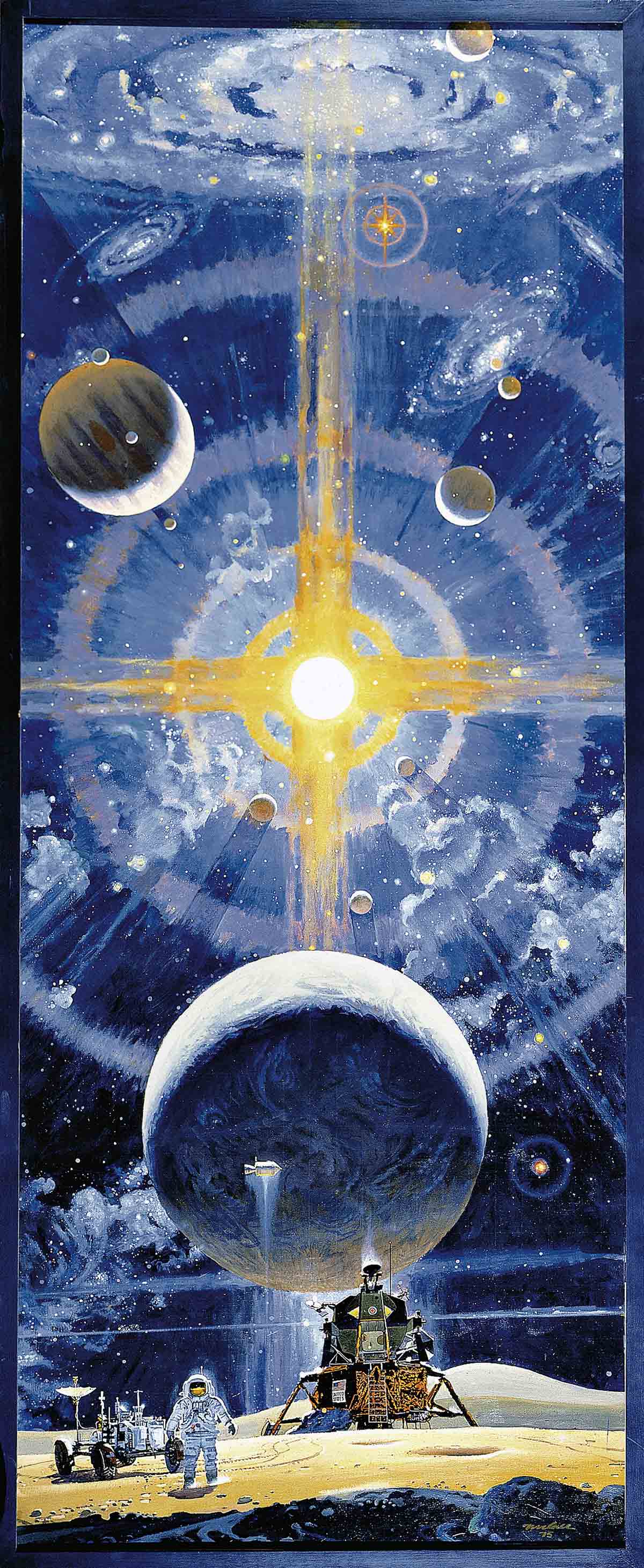
The Space Mural - A Cosmic View (1976), painted by Robert McCall depicts a fictional cosmic vista in celebration of space exploration. Welcome and Introduction (about 3 minutes)
- Welcome participants. Review expectations including how participants will work in pairs.
- Review goals for the day and the overall agenda.
Introduce the Exercise (about 3 minutes)
- Say “We're going to explore how both artists and scientists generate ideas and questions about the world around them, through an "Observe, Think, Wonder" activity!”
- Assign one image from the Astronomical Images, Illustrations, and Artworks List to each pair of participants to complete the exercise.
CalloutNote: Ensure some groups have artwork and scientific illustrations (pages 1–6), and others have telescope images (pages 7–12) to discuss. Do not worry if the same image is repeated among multiple pairs — in fact, we encourage some overlap, which allows participants to hear what others observed, thought, and wondered about the same image. End callout
Facilitator Notes:
- The "Observe, Think, Wonder" model involves three steps: observing (feel-ing/see-ing/listen-ing), interpreting (think-ing), and questioning (wonder-ing).
- This three-step process encourages deeper looking and thus a deeper understanding of even seemingly familiar objects.
- During the exercise, both partners should share their thoughts and take turns. Each partner should encourage and support the other partner to take their turns.
Observe, Think, Wonder (about 12 minutes)
- Allow participants to silently observe their image (about 2 minutes).
- Ask participants to describe exactly what they observe in the image to their partner. Encourage them to note specific details without interpretation or inference (about 3 minutes).
- Invite participants to share what they think about what they see with their partner (about 4 minutes). Participants should interpret and make inferences.
- Ask participants to brainstorm questions they wonder about after observing and thinking about the image with their partner (about 3 minutes).
-
Ask each pair to share one thing they wondered and how it was based on something they observed.
Ideas to reinforce during your discussion:
- In both art and science, a key ingredient of creativity and innovation is learning to ask good questions.
- Note how participants made observations, thought about what they saw, communicated, and asked questions as a result. These are critical skills in both art and science.
- This activity is one that can be used every day, whether participants are walking down a street, listening to a song, or looking at the sky. It can help them learn about the world and ask researchable questions.
If time allows:
Share one or two quotes from the following list, and ask participants to share their thoughts/reactions. Mention whether the person who stated the quote was a famous scientist, artist, or both!
- “Imagination is a huge part of what it means to do science, and I often imagine what it would be like to be up close to these environments.” - Nia Imara (astronomer and visual artist)
- “In our tradition, knowledge comes through careful observation, relationships, and stories passed down. The universe is our guide.” - Dr. David Begay (astronomer)
- "The important thing is not to stop questioning. Curiosity has its own reason for existing." - Albert Einstein (physicist)
- "To me, nothing in the natural world is boring... the more you look at something, the more interesting it becomes." - Lynn Margulis (evolutionary biologist)
- "The more I paint, the more I feel as though I’m developing my powers of observation." - Claude Monet (painter)
- "Learn how to see. Realize that everything connects to everything else.” - Leonardo da Vinci (painter, sculptor, scientist, and engineer)
- "We especially need imagination in science. It is not all mathematics, nor all logic, but it is somewhat beauty and poetry." - Maria Mitchell (astronomer)
- "Nobody sees a flower—really—it is so small it takes time. We haven’t time, and to see takes time.” - Georgia O’Keeffe (modernist painter)
Transition:
Share that in the next Explore activity, participants will learn about planets orbiting other stars (exoplanets). Participants should continue practicing the close observation and questioning skills they learned during this activity when examining the TRAPPIST-1 system.
-
Guiding Questions:
Consider providing the following guiding questions to help each pair observe.
- What draws your attention?
- What colors, shapes, or sizes do you notice?
- What do these objects resemble?
- Are there any patterns or unique features?
Consider providing the following guiding questions to help each pair think.
- What are you thinking about when examining your image/sonification/3D model?
- What do you think is happening in this image/sonification/3D model?
- What evidence (specific details) do you notice that supports your interpretation?
Consider providing the following guiding questions to help each pair wonder.
- What does the image/sonification/3D model make you wonder?
- How might more information or different perspectives change your understanding?
Engagement Tips:
- Participants may be eager to know more contextual details and background information about the image(s) prior to sharing their observations and interpretations. To encourage close observation, fold the bottom half of their paper so that the background information isn’t showing. Encourage participants to first describe only what they see.
- During group and paired discussions, encourage participants to incorporate their personal/cultural/geographic backgrounds into their interpretations and questioning about what they observed. For example, participants may draw connections to music, films, and/or television when describing artistic or telescope images.
- During the Think and Wonder stages of the exercise, encourage participants to read the contextual information provided alongside each image to inform their interpretations.
Background Video:
To familiarize yourself with using the “Observe, Think, Wonder” routine, you can watch this 37-minute webinar video from Smithsonian Education: “Using See, Think, Wonder (Session #1) | Easy PZ.”
Spanish & Portuguese Instructions:
Harvard’s Project Zero provides an overview of the “Observe, Think, Wonder” thinking routine in Spanish: Ver, Pensar, Preguntarse and Portuguese: Vejo, Penso, Pergunto ou Imagino.
Cosmic Stories (Warm up Option 2)
This activity enables participants to practice making observations and conveying ideas while creatively crafting a poem, short story, or song about astronomical models, tactile plates, sonifications, and/or images. It is adapted from NASA’s Universe of Learning’s Astropoetry.
Warm up 2
-
- Printed (in color) images from the Astronomical Images, Illustrations, and Artworks List
- and/or… Astronomy Sonifications (available on YouTube) and/or 3D Tactile Plates (3D-printable as STL or GLB files)
- Chart paper (1 sheet for each group of 4–6 people)
- Markers, pens, or pencils
- Slips of scrap paper, notecards, or post-it notes
- Tape
-
Gather writing materials including chart paper, writing utensils, slips of paper, and tape.
If using printed images, print the images in color. Each pair should have one image.
CalloutNote: The Astronomical Images, Illustrations, and Artworks List contains 12 images. Depending upon the size of your group, you may need to print more than one copy. It’s okay if more than one group uses the same image.End callout
If using the astronomical sonifications and/or 3D tactile plates:
- Sonifications: Prepare the audio files to be played from “A Universe of Sound” webpage, and review the “About the Sonifications” section for more background information about sonification.
- Tactile plates: Use a 3D printer to create tactile models of star life stages or planets. We recommend the Crab Nebula, Orion Nebula, WR 124, or the Eagle Nebula for life stages of stars. For planets, we recommend Jupiter.
-
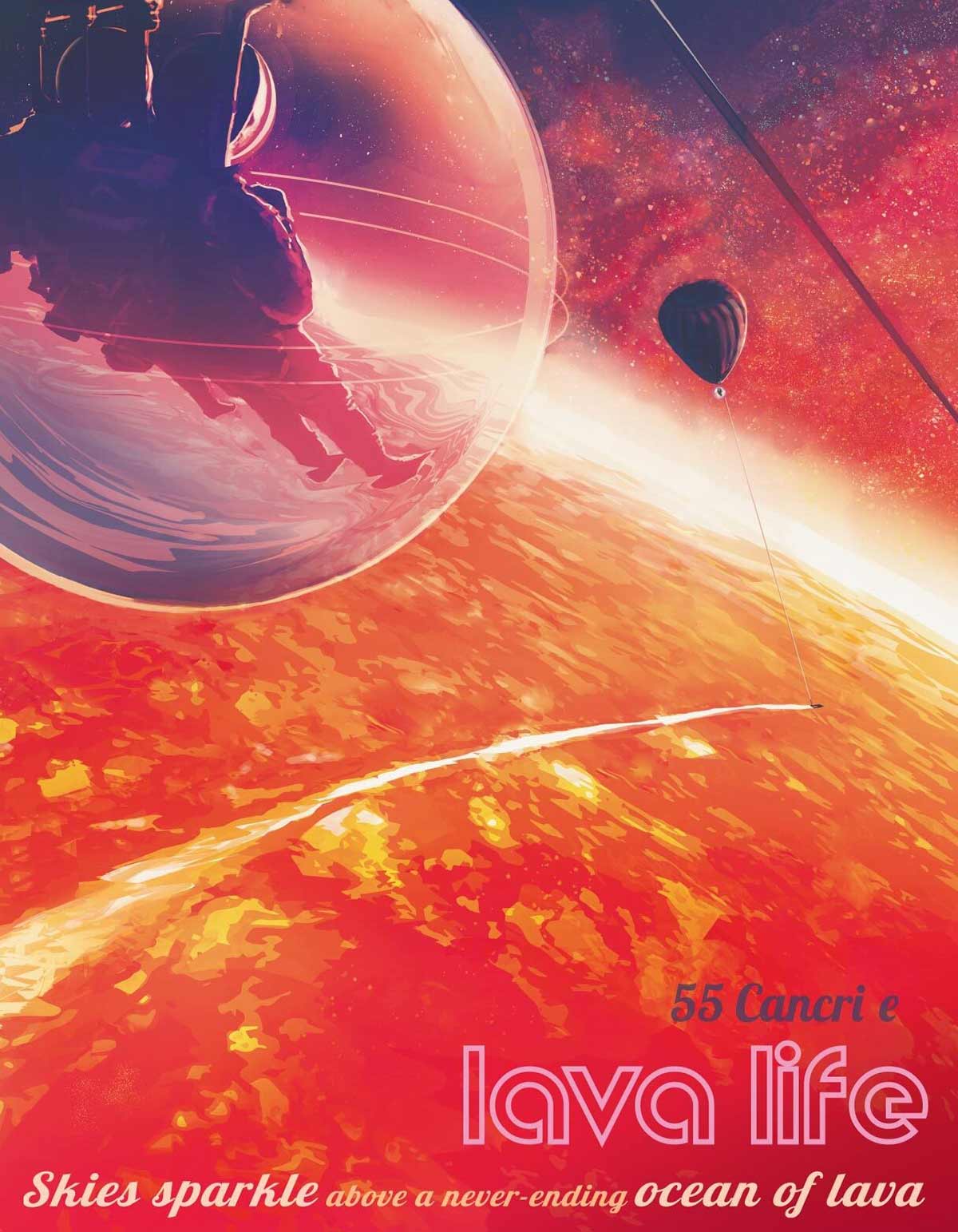
A NASA Exoplanet Travel Bureau series poster depicts a fictionalized view above the exoplanet 55 Cancri e. Welcome and Introduction (about 2 minutes)
- Welcome participants. Review expectations including how participants will work in pairs.
- Review goals for the day and the overall agenda.
Introduce the Exercise (3 minutes)
- Say: “We’re going to use our imaginations, close observation, and communication skills to create a caption, poem, short story, or song inspired by astronomy!”
- If desired, read one or more completed examples and show the accompanying image/ artwork. (See the “Astropoetry/ short story/ lyrics examples” section below.)
- Next, inform participants that to make their poem, short story, or song, they will study an image, jot descriptive words on slips of paper, and reorganize them into a final piece.
Create Stories, Poems, and/or Songs (15 minutes)
- Form groups and distribute materials:
- Divide the participants into groups, with ideally 2–3 youth-adult pairs (for a total of 4–6 people) per group.
- Distribute the astronomical images, illustrations, artworks, writing utensils, and slips of paper to each group.
CalloutNote: Encourage at least one group to select an astronomical image (if none have selected one) and/or one group to select a scientific illustration or artwork for the activity (if none have selected one). This encourages close looking and creative expression in response to both astronomical art (paintings, illustrations, etc.) and data (telescope images).End callout
Generate Words and Short Phrases:
- Encourage participants to closely examine their image and write down single words and/or short phrases that describe the image and/or what it reminds them of.
- Participants should generate a mix of adjectives, nouns, adverbs, and verbs.
- Instruct them to write one word or a very short phrase (at most two words) per slip of paper.
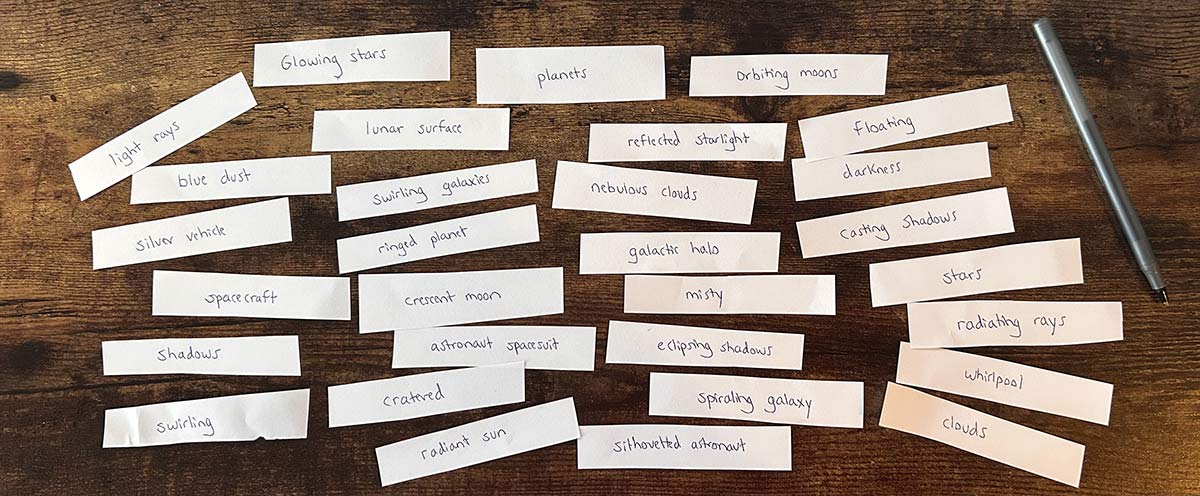
30 descriptive words and short phrases participants wrote on strips of paper to describe Robert McCall’s The Space Mural - A Cosmic View (1976). Assemble the “Stories”:
- Once each group has at least 30 slips of paper, have participants work together to arrange the words into a poem, story, or song in any manner they like.
- Encourage participants to add words such as: it, the, like, a, as, etc… to connect their words and phrases.
- Participants do not need to use every word they write.
- While participants organize their words and/or short phrases, distribute a sheet of chart paper to each group.
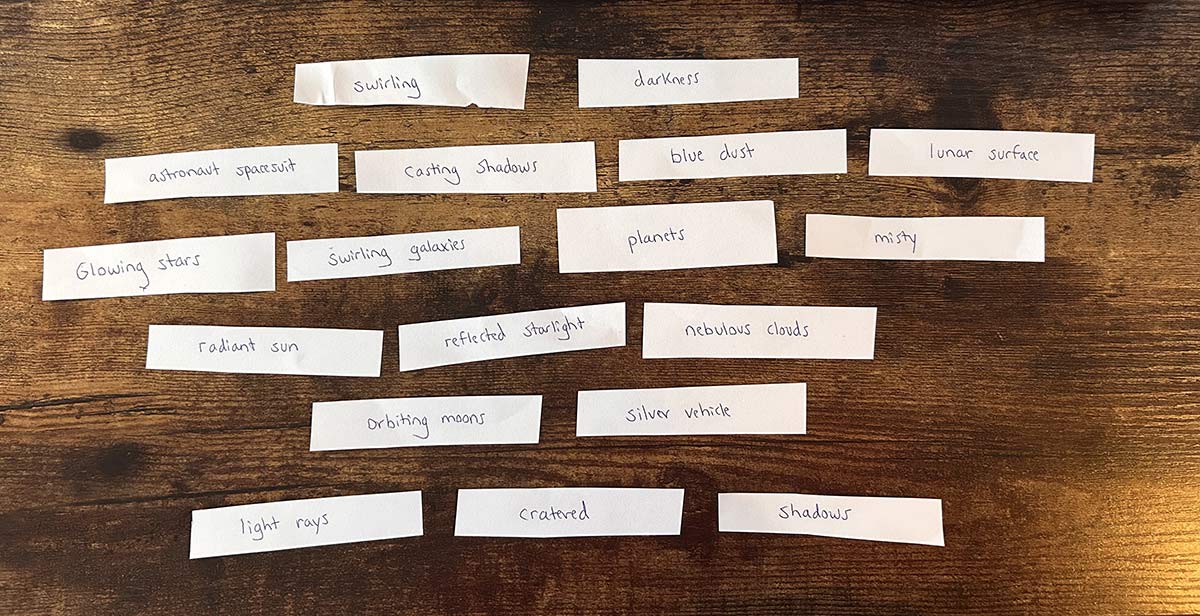
Participants rearranged 18 of their descriptive words and short phrases into a poem describing Robert McCall’s The Space Mural - A Cosmic View (1976). After adding filler words, their poem read as: In the swirling darkness of space, an astronaut spacesuit is casting shadows in blue dust on the lunar surface. Glowing stars, swirling galaxies, and planets paint a misty sky above, while radiant sunbeams scatter across reflected starlight and nebulous clouds. Amidst orbiting moons, a silver vehicle awaits its rider, veiled by light rays and cratered shadows. -
Share:
- Groups should transfer their final story, poem, or song onto the chart paper, taping down the slips and/or rewriting their words.
- They should tape the image onto the chart paper, title their poem/story/song, and add their names.
- Display each groups’ creation in front of all participants.
- A volunteer from one or two groups should share their poem/story/song with the other groups and describe their thought process for creating their piece.
Ideas for you to reinforce in your discussion:
- In both art and science, original thinking based on the world around you is essential.
- During this activity, participants made observations, thought about what they saw, communicated with each other, and generated a new way of looking at the world. This is something artists and scientists do every day.
Transition:
Share that in the next activity, participants will be working with a model that helps tell a story about planets outside of our solar system (exoplanets). While part of scientists’ jobs is to tell stories rooted in observations and facts, they still need to think creatively about how to interpret and share what they have observed.
-
Stay active and iterative:
Encourage participants to actively rearrange the words when creating their poem/short story/song. The process should be collaborative and iterative — just like science! Also, inform participants that they will be sharing their poems in front of the group. If you feel as though some groups may be hesitant to share their work out loud, encourage the full group to contribute and/or ask for a single representative to share.
Change up the images:
If you and/or participants have access to an internet-connected device during the program, they can go to Astropix.org and search for “stellar evolution,” “exoplanet,” or other astronomical terms to find astronomical images and/or scientific illustrations to inspire their work. Once you search for a particular term or object name, participants can filter the results by “Image Type” in the right-hand column to show only “Artwork” or only an astronomical “Observation.”
Add additional flourishes:
Encourage participants to get creative and make their stories their own by adding intonation, rhythm, and/or melody to their short poem, song, and/or story.
For blind and low vision participants:
Materials: Rather than images, provide participants with one or more of the following types of material(s) to explore when creating their story, poem, or song:
- Astronomy Sonifications (available on YouTube) and/or 3D Tactile Plates (3D-printable as STL or GLB files)
- Check out the “About the Sonifications” section for more background information on sonification.
-
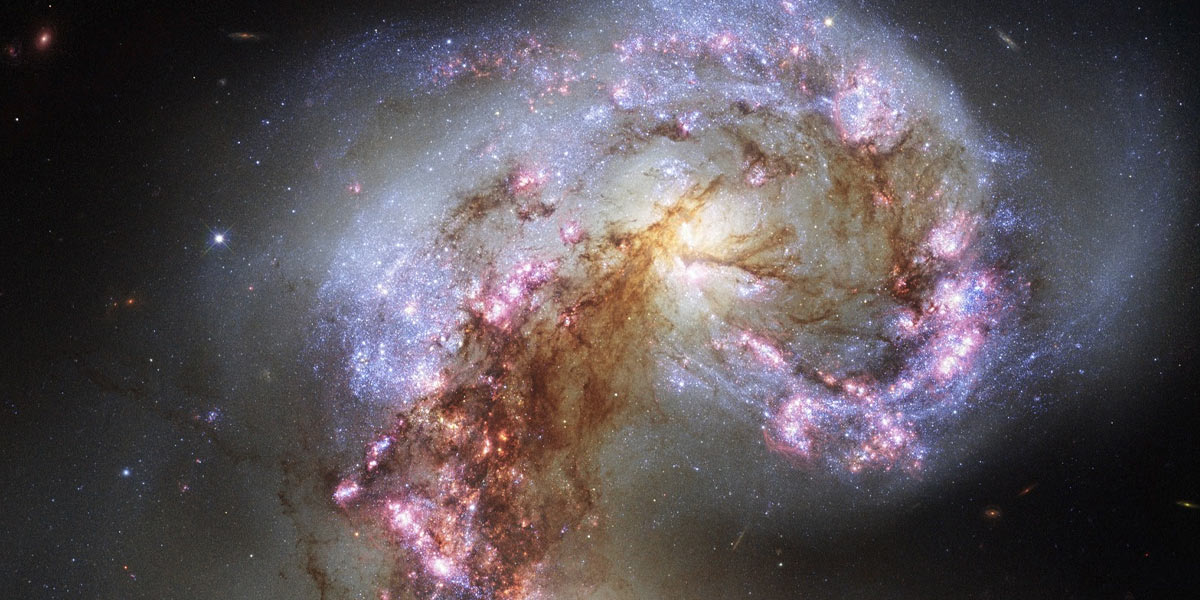 Antennae Galaxy (Image source):
A magnificent, bright, red, fireball-like heart is moving…
An exploding fuzzy dark aura of dust is expanding…
Morphing blue and yellow fire are colliding to become the origin of stars…
A giant shrimp is born.
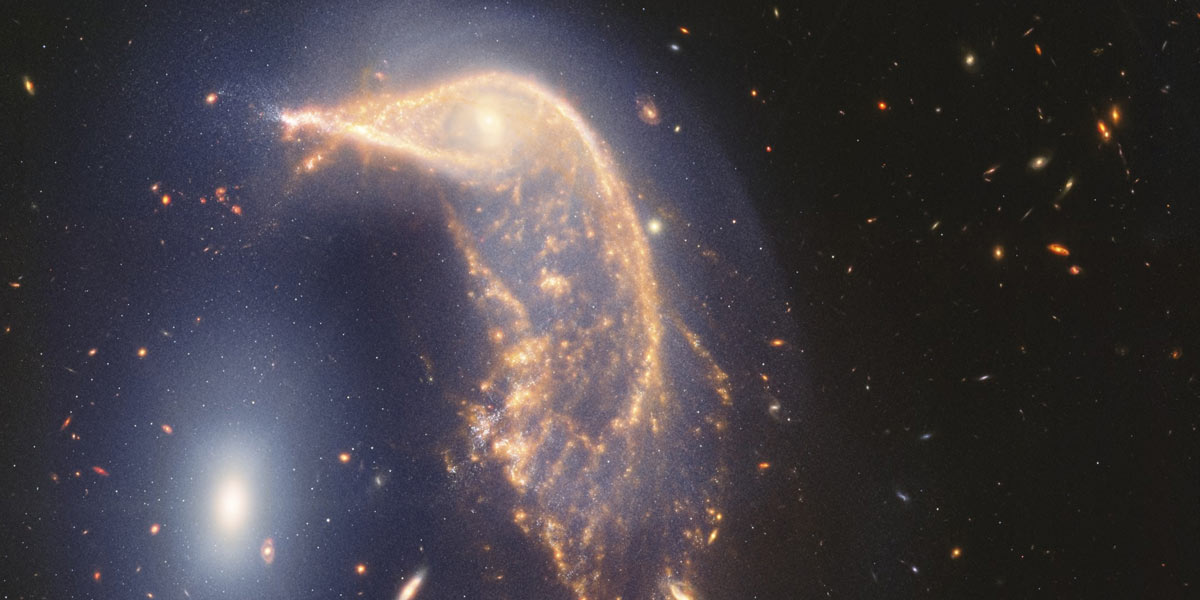
Interacting Galaxies Arp 142 (Image source):
In swirling splendor, galaxies dance,
A Penguin watches over an Egg in a cosmic trance.
Yellowish stars ignite in the background,
With two white, pointy stars dangling like ornaments.
L1527 and Protostar (Image source):
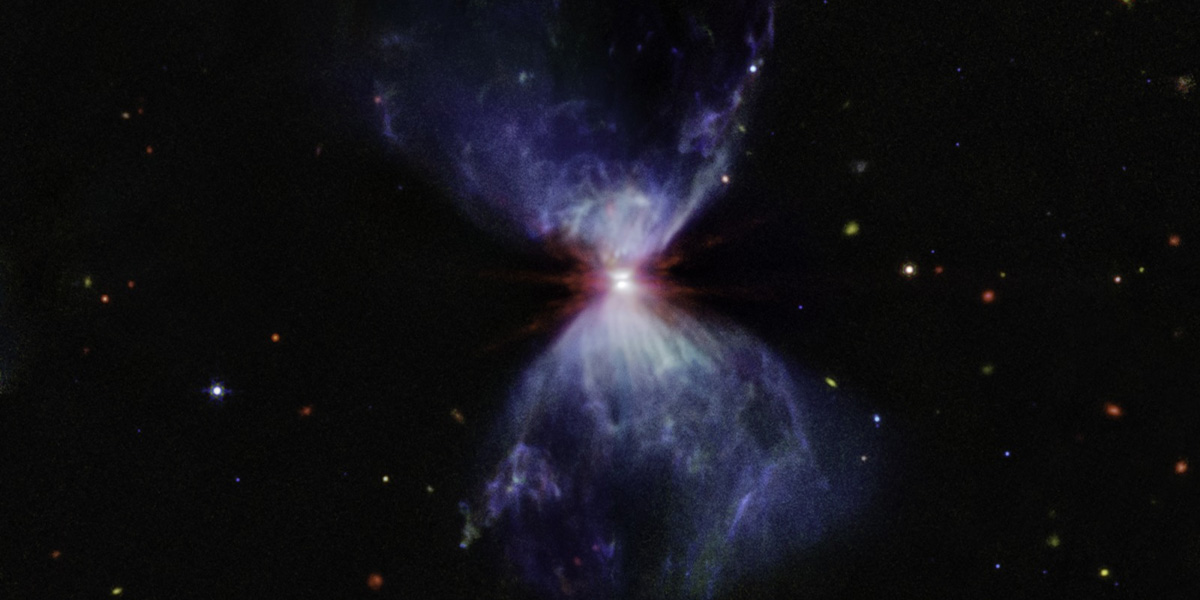
In a glowing, blue feathery hourglass,
A red heart beats, with streams of light.
Clouds of white and blue plumes rise,
Twinkling red, yellow, and blue stars in cosmic skies.
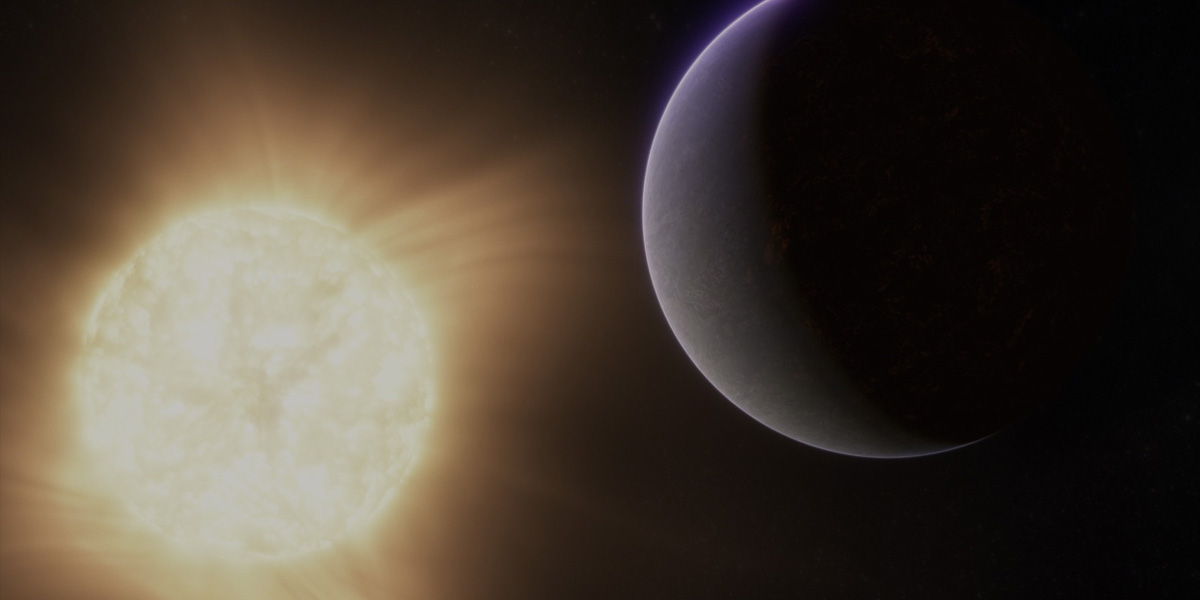
Super-Earth Exoplanet 55 Cancri e (Image source):
A blazing yellow star with long streams of light,
Makes one side of a planet bright,
The planet’s sky is pinkish and white,
With swirls of grays and reds, its rocky surface looks like a sundae delight.
Explore
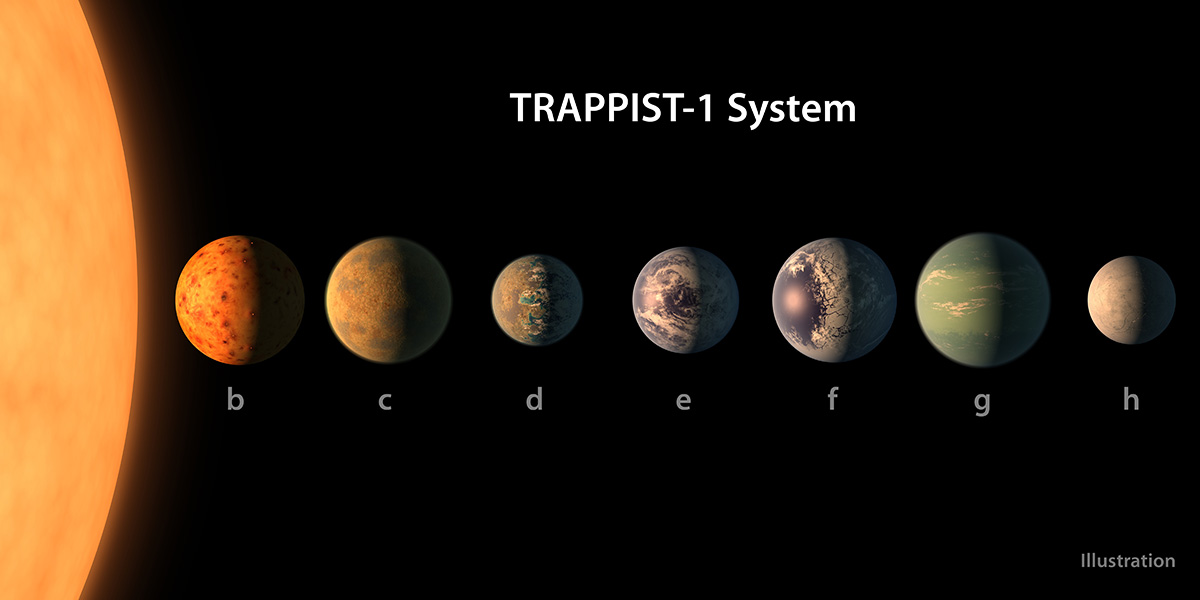
Draw from the Data: Illustrating the TRAPPIST-1 Exoplanets
Planets beyond our solar system, called “exoplanets,” were long imagined to exist but only confirmed in 1992. Since then, thousands have been detected, including seven planets around a single star named TRAPPIST-1, the largest group of roughly Earth-sized planets ever found in a single stellar system. Using data from space- and ground-based telescopes, astronomers use the TRAPPIST-1 system as a laboratory to study rocky planets around other stars.
In this activity, participants will discover how artists study and depict exoplanets by exploring a scale model of the TRAPPIST-1 system, and comparing scientific data and illustrations of the seven TRAPPIST-1 exoplanets as they’ve been depicted over time.
Learning Concepts:
Participants will learn that:
- Exoplanets are planets outside of our solar system.
- Even though exoplanets are far away, we can make measurements to learn about them.
- Most images of exoplanets are scientific illustrations. They are based on what we know about exoplanets through telescope data and also draw upon information we’ve learned from studying planets in our own solar system.
- Science is an iterative process. As we collect more data about exoplanets, how we envision them through illustrations can change.
- Models are not perfect representations but are useful tools for understanding, studying, discussing, and explaining astronomical phenomena according to current data.
Time:
- Preparation: about 15 minutes
- Activity: about 30 minutes
Activities to Explore
-
- Printed 2017 TRAPPIST-1 Scale Model & Facts Sheet (color, single-sided, 1 set)
- Printed 2017 & 2021 TRAPPIST-1 Data Tables (color, single-sided, 1 set for every 2–3 participant pairs)
- Tape measure
- Tape or tacky putty
- Recommended (but optional): An internet connected device to show participants the “Drawing from the Data: Illustrating the TRAPPIST-1 Exoplanets” video, narrated by astronomer and scientific illustrator Dr. Robert Hurt.
-
- Recommended: Load and/or download our YouTube video “Drawing from the Data: Illustrating the TRAPPIST-1 Exoplanets”, so it is ready to be shared with participants. This video can help frame your final group reflection after participants examine the data tables.
- Set up a scale model of the TRAPPIST-1 system using the 2017 TRAPPIST-1 Scale Model & Facts Sheet.
- Print the 2017 TRAPPIST-1 Scale Model and Facts Sheet as single-sided and in color, and cut apart pages 2 and 3 along the dashed lines to create 16 cards.
- Attach the black TRAPPIST-1A star card (from page 2) to a wall or table surface.
- Measure the “Distance from star at scale” (written at the bottom of each planet’s Fact card) from where you placed the TRAPPIST-1A star card, using your tape measure. Place each planet’s Scale Model card at the corresponding distance along the tape.
- Scale Model cards have black dots rather than the illustrations of each exoplanet’s surface.
- Next, place each planet’s Fact card directly above or below each Scale Model card. See example in photo below.
CalloutNote: You may want to set up multiple models for a program with a large number of participants. An optional approach — although it will take more time — is to have your participants set up the scale model themselves using the cards. Check out the Tips and Adaptations section below for other ideas about how you can set up the model.End callout
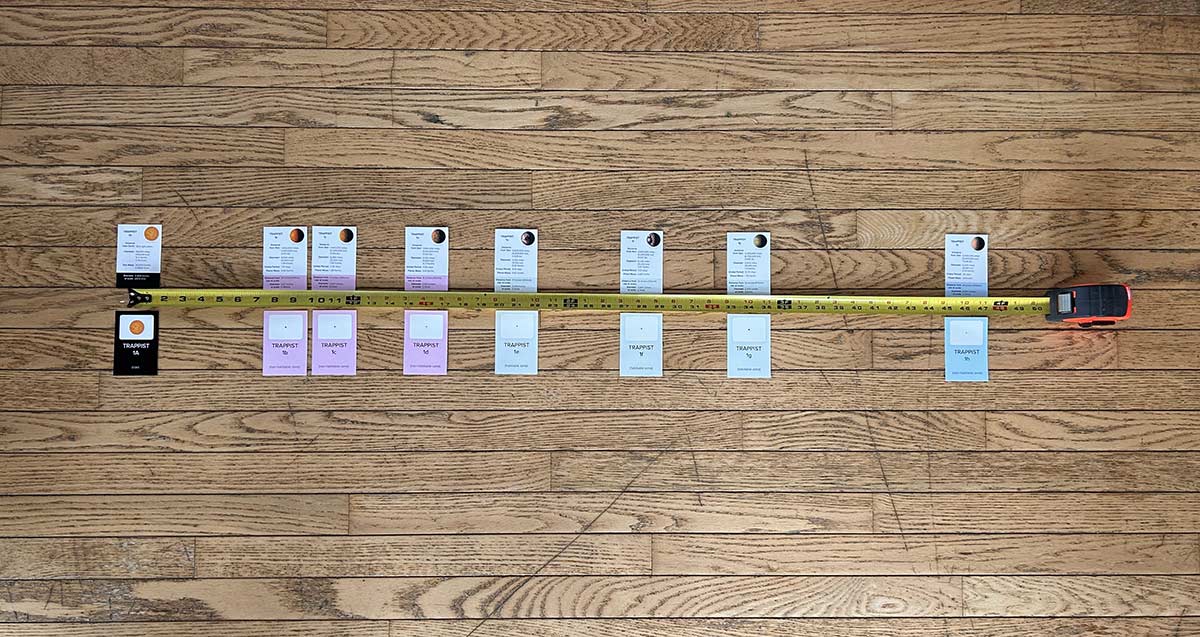
Example setup of the TRAPPIST-1 scale model. The TRAPPIST-1 star card appears on the lower left, the Scale Model cards appear at their corresponding distances below the tape measure, and each planet’s corresponding Fact Card appears above its position along the tape. - Prepare the updated exoplanet illustrations and data tables by printing one copy of the 2017 & 2021 TRAPPIST-1 Data Tables as single-sided and in color for every 2–3 pairs of participants to examine.
-
Introduce Exoplanets and the Transit Method (5–10 minutes)
- Introduce participants to the following concepts:
Exoplanets:
- Planets outside of our solar system are called “exoplanets.” People have long imagined that exoplanets exist, but it is only since the 1990s that we have confirmed they exist.
- It is estimated that there is at least one planet for every star in every galaxy. That means there are billions of planets in just our own Milky Way galaxy.
- Optional: Encourage participants to share their favorite fictional planets. In science fiction, there are all sorts of planets that are similar to or different from those in our solar system. Note that, unlike science fiction, exoplanets are too far away for us to visit.
- We study exoplanets because they help us understand the variety of planetary systems, the potential for life beyond Earth, and how planets (including our own) form and change over time.
Transit method:
- Exoplanets are light-years away from Earth — much too far for us to take photos of their surfaces. (A light-year is the distance light travels in one year, roughly equal to 5.88 trillion miles or 9.46 trillion kilometers.)
- Telescopes detect exoplanets by looking at stars and measuring slight changes caused by the exoplanets. For example, a star’s brightness may dip due to an exoplanet periodically passing between the star and the observer. This is called the “transit method” of detecting an exoplanet and can provide information about the planet’s atmosphere, surface temperatures, size, and orbit. Most exoplanets — including the TRAPPIST-1 system exoplanets — have been discovered using this method (although other detection methods exist).
- Using telescope data, plus what we know about our own solar system, artists create illustrations of what an exoplanet might look like.
- Optional background videos to share:
- Play National Public Radio’s audio clip “Out Of This World: How Artists Imagine Planets Yet Unseen” (audio duration: 4 minutes)
- Play NASA JPL’s video: “Art of Astrophysics” (video duration: 2 minutes)
- Optional background videos to share:
Discuss the TRAPPIST-1 Scale Model (about 10 minutes)
- Share with participants…
- Today we’re going to investigate an exoplanet solar system around a distant star astronomers named TRAPPIST-1.
- The TRAPPIST-1 system is fascinating because:
- It is the only known system with seven terrestrial (rocky) planets orbiting a single star.
- The seven TRAPPIST-1 planets orbit quite close together, so scientists can study how their gravity affects one another. Because their gravitational pulls create measurable changes in their orbits over time, scientists have been able to very accurately determine each planet’s mass, giving us a clearer picture of what each planet might be made of.
- At least three planets in the TRAPPIST-1 system are within or near the habitable zone, where liquid water could exist. This makes the planets candidates for studying habitability outside our solar system.
CalloutPlanets shown within the “habitable zone” are capable of having liquid water on their surface, not just steam or ice. However, it doesn’t mean that something lives there.End callout
- Encourage pairs to examine the TRAPPIST-1 scale model setup and discuss their observations among themselves. What do they notice? What questions does it raise?
- Facilitate a group discussion about the Scale Model cards (NOT the corresponding Fact cards). Questions to ask participants may include:
- What does this model allow you to compare and/or understand? The model shows the number of planets in the system, the distance between each of the planets and their host star, the relative sizes of the planets and their host star, and which planets are in the “habitable zone” vs. “non-habitable zone.” The model allows you to easily compare the sizes and positions of the planets in relation to one another and the TRAPPIST-1 star.
- What information is difficult to understand in this model? What the planets look like, what conditions are like on their surfaces, and how big they are in comparison to one another. (There is only a very slight variation in the size of the planets). We also can’t tell where they are positioned around the TRAPPIST-1 star in relation to one another. Since we lined them up along the measuring tape, they appear in a straight line.
- Why do the planets look so small in this model? As a scale model, both the sizes of the planets (in relation to one another and their star), and the distances between them are proportionally reduced to a smaller scale. This allows people to visually understand the relative sizes and distances between the celestial bodies. Because the planets are so much smaller than the star they orbit, they’re shown only as tiny dots in this model.
- How far away from the star do you think Earth would be if we set up a model of our solar system at the same scale? Answer: 64 feet (19 meters away). Our Sun, at the same scale, would be about the size of a baseball!
- Facilitate a group discussion about the model, now including the Fact cards for each planet. Questions to ask participants may include:
- What additional information do the illustrations on the Fact cards provide? The TRAPPIST-1 exoplanets appear to be rocky (terrestrial) planets. Some appear to have water on their surfaces, and some have clouds.
- After looking at this model, what might you infer about how conditions on the TRAPPIST-1 planets might be different from one another? Given what we know about how gravity works, we can infer that planets with lower mass (like TRAPPIST-1 d) have less gravitational pull on their surface. Given how stellar energy travels, we could also infer that planets orbiting farther from the star, like TRAPPIST-1 h, are receiving less energy from their star and are likely colder.
- How do the TRAPPIST-1 planets compare to Earth? According to the data on the Fact cards, they are all approximately the same mass as Earth. However, they orbit their star much faster (in 1.5 to 20 days) than Earth orbits our Sun (about 365 days). They are also positioned much closer to their star.
CalloutExplain that 1 AU, or astronomical unit, is the average distance between Earth and the Sun.End callout
Investigate How the TRAPPIST-1 Illustrations Have Changed (about 10 minutes)
- Explain: This scale model is one way of representing what scientists know. Now, we’ll closely examine scientific illustrations of the exoplanets. Each group will receive: a) illustrations of the TRAPPIST-1 exoplanets showing how scientists imagined them in 2017 and 2021, b) a data table showing some statistics of our solar system’s rocky planets, and c) a graph showing how the TRAPPIST-1 exoplanets’ sizes, densities, and illumination levels compare to the rocky planets in our solar system. Each illustration shows what each exoplanet could look like based on the data scientists had at the time (which is listed below each illustration). Keep in mind that we continue to gather data about the TRAPPIST-1 system.
- Break participants into groups of 2–3 pairs (4–6 people) and give each group a printed set of the 2017 & 2021 TRAPPIST-1 Data Tables. Encourage each group to:
- Compare and contrast the newer and older data. Discuss: What (if anything) changed in the data?
- Compare and contrast the older and newer illustrations. Discuss: What changes do they notice?
CalloutEncourage participants to look beyond color choices, instead focusing on the planets’ surfaces, whether they have water or not, cloud cover/atmosphere, etc.End callout
- Discuss why they think the illustrations changed over time.
- Examine the TRAPPIST-1/ Solar System Comparison graph on page 5. Discuss: How do the TRAPPIST-1 exoplanets compare to rocky planets in our solar system? How might our knowledge of neighboring rocky planets help us imagine the TRAPPIST-1 exoplanets?
-
- Recommended: Before your group discussion, show participants our “Drawing from the Data: Illustrating the TRAPPIST-1 Exoplanets” video, narrated by astronomer and scientific illustrator Dr. Robert Hurt.
- If you are unable to show the video: Refer to the TRAPPIST-1 Discoveries & Illustration Explanations table to discuss how new discoveries shaped the illustrations of the TRAPPIST-1 exoplanets from 2017 to 2021 and beyond.
- Optional: You can use the TRAPPIST-1 Exoplanets - FAQs Sheet to help answer additional questions during the discussion.
- Use the following big ideas (and questions) to guide your discussion:
Scientific illustrations communicate our ideas of what exoplanets are like:- Many of the "images" of exoplanets that you may see, including the ones in this activity, are actually illustrations. Despite advances in telescope technology, no current or planned telescope will show exoplanets as clear pictures, like we have for planets within our solar system. Even in the future, the best images of exoplanets will only be a few pixels.
- Since we can't take photos of exoplanets like we do for planets in our solar system, illustrations will remain our best tool for depicting what these distant worlds might look like based on the data we gather.
- Each illustration acts like a scientific hypothesis, a prediction of what the planet could look like based on the available data.
- Ask participants: Can you think of a time you had to create an illustration, such as a diagram, to convey information? What, if anything, made the process challenging?
How we illustrate the TRAPPIST-1 exoplanets has changed to reflect new data:
- The facts below each planet are based on data collected at that time, but they don’t show the uncertainty. As more data was gathered, the uncertainty decreased. Scientific illustrators revised the illustrations to better reflect the new, more accurate numbers.
- Scientists often update their understanding based on better, more accurate data. This does not mean that the researchers who collected the original data made mistakes or were sloppy. Instead, more observations, often made with different instruments or telescopes, can give us a more complete picture over time. Better data can help us rule out certain possibilities and suggest others that are more likely.
- Ask participants: Can you think of a time you changed your mind when you got more information?
Transition:
In the next activity, you will be the illustrator, using the details we know about an exoplanet to envision what it might look like. Consider how the skills that artists and scientists use overlap, and how you might incorporate art styles you enjoy into the activity.
-
Have participants set up the model:
Rather than setting up the TRAPPIST-1 scale model in advance, have your participants set up the model using the cards and the distances written on each card (as outlined in the Preparation section).
Explore an interactive TRAPPIST-1 system model:
Using NASA’s Eyes on Exoplanets webpage, participants can explore animated 3D models of the TRAPPIST-1 system. From this page, click “Star” to see TRAPPIST-1 up close, rotate and zoom in on each exoplanet using the “Planet” tab, and click the “Compare to our Solar System” button to display the TRAPPIST-1 system alongside the orbits of planets in our solar system.
Compare/contrast our solar system and the TRAPPIST-1 system:
Cut out and fold cards depicting our Sun and the planets within our solar system (you can find them within this TRAPPIST-1 Scale Model Set on pages 6–8). The scale image of our Sun can be placed alongside TRAPPIST-1, but the location of the planets may need to be described via nearby landmarks due to the much larger scale. Determine at least where Earth would be at this scale (64 feet or 19 meters away).
- To engage participants, you can ask them to guess where each of the planets within our solar system would fall given the same scale as the TRAPPIST-1 model before revealing the “Distance from star at scale” information on the back of each planet card.
- To get participants moving (if you have access to an outdoor space, such as a field), you can ask them to walk to the distances where they think the rocky planets in our solar system would be.
Change the model setup:
If you have 7 feet of wall space available, you can place the TRAPPIST-1A star card at the center. Then, place some of the planets to the right and some to the left of the star to create a more realistic model.
Create!
Make Your Own Exoplanet Model
In this activity, youth-adult pairs will design and create their own exoplanets. Participants will imagine an exoplanet that could exist, complete with distinct features and characteristics, and then use art supplies to bring their vision to life. This activity encourages creativity while helping participants practice communicating scientific ideas.
Learning Concepts:
Participants will:
- Practice their artistic skills through designing an illustrated exoplanet model.
- Practice their communication skills by visualizing the environmental, chemical, and/or physical characteristics of hypothetical exoplanets and by describing their models.
- Enhance their teamwork skills through collaboratively planning, discussing, and designing their exoplanet.
Time:
- Preparation: about 15 minutes
- Activity: about 35 minutes
Activities
-
- Poster board or a large sheet of paper: 1 per pair
- Markers, pens, colored pencils, crayons, and/or paint (variety of colors)
- Glue and/or tape
- Choose one of the following (according to interest/internet connectivity):
- Exoplanet Descriptions Sheet: 1 printed copy cut into strips along the dotted lines.
- Random Exoplanet Generator Spreadsheet: Participants can use this spreadsheet to generate a different, random set of exoplanet descriptions each time the page is opened and refreshed.
Optional:
- Scissors (straight and decorative edges)
- Materials such as cotton balls, sand, pebbles, textured and/or colored paper, yarn, fabric scraps, cellophane, etc. (for texture/details)
-
- Prepare examples: You can print out or prepare to show on a screen one or more examples of images of Earth seen from afar, as well as space telescope images of planets within our solar system, such as Hubble’s view of Jupiter, Saturn, and/or Mars.
- If you have access to a printer, print and cut apart the descriptions on the Exoplanet Descriptions Sheet. Place paper strips in a bowl, hat, or on a table for participants to choose from. If you’d prefer not to print descriptions and will have access to the internet during your program, pre-load the Random Exoplanet Generator Spreadsheet for participants to use instead.
- Set-up art-making spaces for each pair with the materials listed above.
-
Introduce the Exercise (5 minutes)
- Discuss how different features and characteristics of a planet, such as its atmosphere, terrain, size, and climate might affect the planet’s appearance. Show participants one or more examples of images of Earth seen from afar as well as space telescope images of planets within our solar system, such as Hubble’s view of Jupiter, Saturn, and/or Mars.
- As participants view the images, ask: What features stand out to you? What differences do you notice between how these planets look, and what might that tell us about the planet(s)?
- Reiterate: Exoplanets are too far away from Earth to send spaceships or probes to, and current telescopes can’t capture clear images of them. Scientific illustrators use data collected by telescopes to create illustrations of what they may look like. This includes information like the planet’s size, temperature, distance between the planet and its star, and what chemicals its atmosphere is made of.
Create the Models (about 20 minutes)
- Pairs select an exoplanet description:
- Option one: From the Exoplanet Descriptions Sheet pieces, have each pair select an exoplanet description (either at random from a bowl/hat or after viewing all the strips of paper and selecting one of their choice).
- Option two: Alternatively, participants can select an exoplanet description from the online Random Exoplanet Generator Spreadsheet.
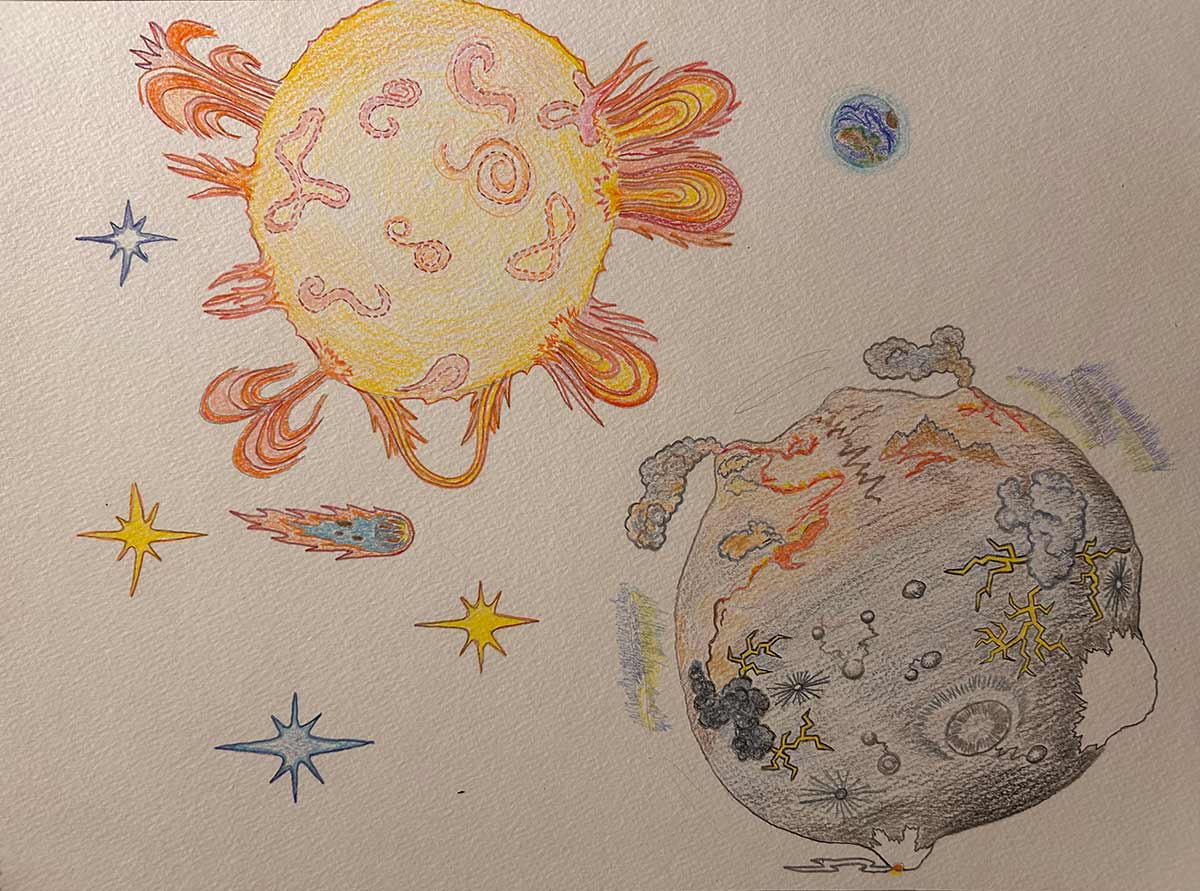
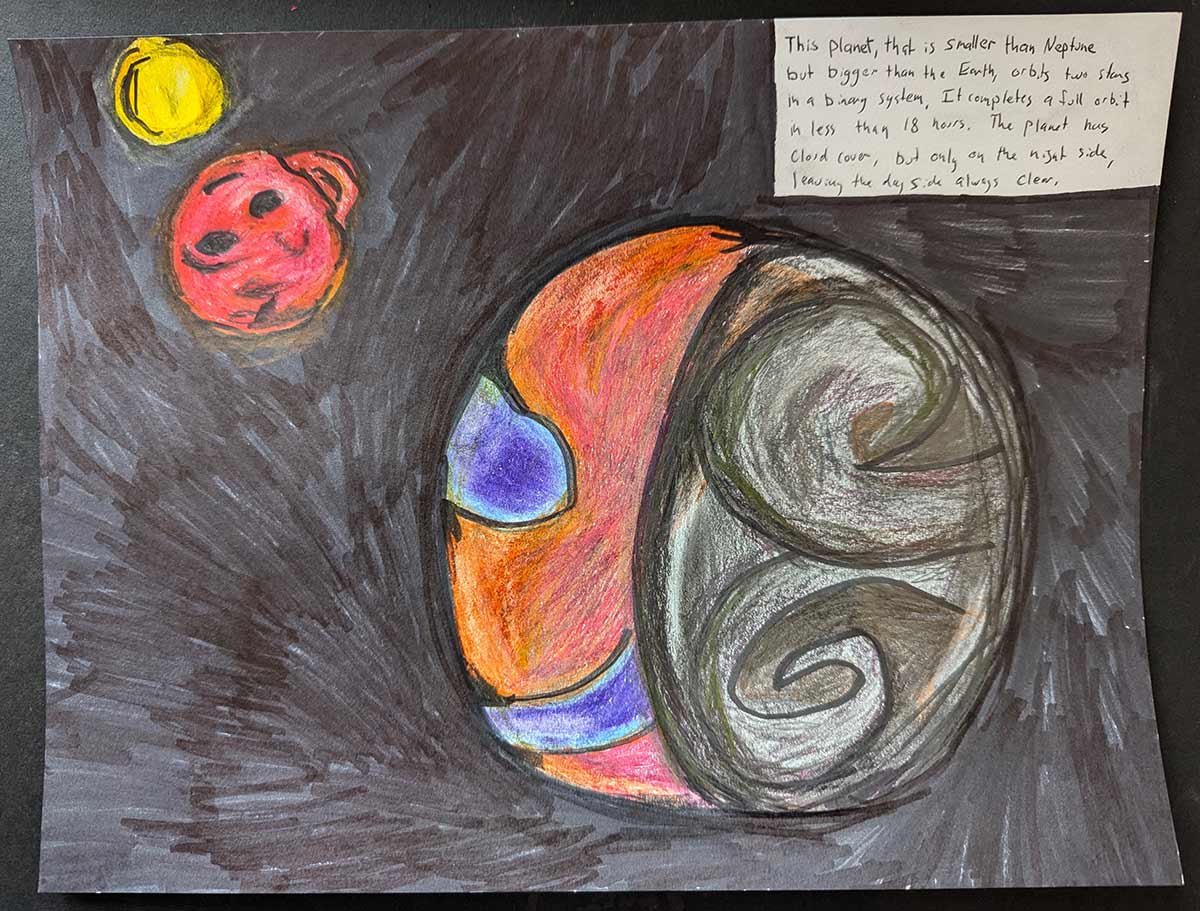
A colored pencil drawing created to depict the following Exoplanet Descriptions Sheet prompt: “A small rocky planet about the same size as Mercury orbits an orange-red star that regularly sends out giant flares. It completes its orbit in just two days, far faster than any planet in the solar system. The planet has one side that always faces its star, and one side that always faces away from its star (like the Moon and the Earth).” Note that the participant added additional details to their planet not included in their prompt, such as mountains and volcanoes, lightning storms, craters, and ice caps on the colder side facing away from its star. - Pairs plan their model design:
Ask each pair to brainstorm and discuss how they’ll use their art materials to depict their exoplanet on paper. Encourage participants to add features to its surface and surroundings according to what characteristics they chose. Encourage participants to add additional details if they want to convey more detailed information about their exoplanet. For example, participants might want to draw canyons on a rocky surface, add lightning into a stormy atmosphere, or include oceans on a planet that has liquid water on its surface.
- Pairs illustrate their exoplanet:
Share the following guiding questions for participants to consider when visualizing their exoplanet:
- How big/small is your planet?
- Is your planet close or far away from its star? How hot or cold is the planet?
- Does your planet rotate on its axis like Earth, or is it tidally locked (with one side permanently facing its star)? How might this affect how you depict both sides?
- Does your planet have water? What forms does it take?
- Does your exoplanet have an atmosphere? Is it calm or stormy?
- Might your exoplanet support life? (Consider the temperature, presence of water, etc.)
- What is your planet made of? Rock, gas, and/or metal?
- From how far away are you viewing your planet?
- What geological features (e.g., volcanoes, lava fields, mountain ranges, and canyons) are present on the surface of your exoplanet?
- Does your planet have rings surrounding it? Any moons or other nearby objects?
-
Share:
- Have pairs share their exoplanet creations with the group by describing the decisions they made about their planet.
- Ask: What information informed how you depicted your exoplanet? What was most challenging about creating your model?
Ideas for you to reinforce in your discussion:
- Models are imperfect representations, but they’re very useful: What participants just created is a model of an exoplanet. Models like this, along with the scale model from the first activity, help us focus on specific aspects of the universe, even though they don't fully represent everything. Scientists often use models like these in their work, and the artistic elements are key in helping us form a picture of the universe that we can understand, analyze, discuss, and relate to as humans.
- Ask: Can you think of other examples of how models are used to visually communicate ideas? Examples might include model cars, weather maps, illustrations of ecosystems, and depictions of atoms.
- Ask: What connections did you notice between art and science based on your experience in this program? Ask participants to describe how they used art to communicate scientific ideas.
-
Draw-pair-share:
- If each participant would prefer to draw their own exoplanet, encourage both members of each pair to create their own artwork and compare how their depictions were similar to and different from their partner’s during the group share-out. This is an ideal scenario to discuss how data can be interpreted differently.
Create a travel or movie poster for an exoplanet:
- Share examples from NASA’s Exoplanet Travel Bureau or Galaxy of Horrors with participants for inspiration. Alternatively, display some examples of how scientific illustrators have envisioned exoplanets by searching for “exoplanet” on Astropix.org and then filtering the results by “Artwork” under “Image Type” (on the left side panel).
Encourage participants to name their exoplanet:
- Explain that astronomers typically name exoplanets based on a standardized system established by the International Astronomical Union (IAU). Through this system, the host star’s name is listed first, then a letter representing the exoplanet. The first discovered exoplanet is assigned “b,” the next one “c”, and so on. Under this system, exoplanets orbiting the star HD 209458 would be named “HD 209458 b” and ‘HD 209458 c.” In some cases, exoplanets are given more common names through public voting or cultural references. These names often reflect mythology, history, or notable figures.
Build a paper-mache model:
- If you have more time with the participants, they can create a three-dimensional model of their exoplanet using paper-mache (either in addition to or instead of creating a poster). Check out our Paper-Mache Exoplanet Model Instructions, which include a materials list and step-by-step directions.
Encourage pairs to conduct background research:
- If participants are unsure where to start, want to explore more reference images for inspiration, and/or would like guidance for which color(s) they should use to depict certain minerals and elements (e.g., olivine, iron, and liquid mercury), suggest they browse exoplanet illustrations on Astropix.org using the “Artwork” filter in the upper left-hand column. They can also search for images of “olivine,” “iron,” and more using Google’s image search.
Create an art display:
- Participants can leave their exoplanets after the program to create an exoplanetary system gallery. Get creative with the display—hang posters on a wall with the exoplanets’ and artists' names, or suspend paper-mache models from the ceiling within a safe distance away from a light fixture to represent them orbiting a host star. You could even use a basketball, beachball, or another paper-mache model to represent a host star at the center of your display.
For blind and low vision learners:
- Participants can build a 3D model of their exoplanet, either using building blocks (like Lego bricks), modeling clay, and/or paper-mache. Check out our Paper-Mache Exoplanet Model Instructions, which include a materials list and step-by-step directions.
- Alternatively, participants can sonify a planetary system using NASA’s Space Jam. Sonification is the process that translates data (in this case, the ones and zeroes captured by telescopes) into sound.
Background Resources
Resources by Type
-
- NASA Exoplanets: Website with information about exoplanets, including recent exoplanet discoveries, designed for a general audience.
- Webb's Impact on Exoplanet Research: What are planets around other stars like? What are they made of? How did they form? How are we studying them?
- Out Of This World: How Artists Imagine Planets Yet Unseen: National Public Radio article (and audio story) describing how scientific illustrations of exoplanets are made.
- The Art of Exoplanets: How do scientific illustrators visualize distant worlds that we can’t directly see? Learn how in this article, and watch the accompanying video.
- The Visionary Astral Paintings That Inspired Space Exploration: Forbes article about how space art inspired early space exploration.
-
- Eyes on Exoplanets: An interactive map of all known exoplanets.
- Exoplanet Variety: Orbital Distance: Through this interactive slider, users can learn more about the seven Earth-sized planets orbiting the TRAPPIST-1 star.
- Exoplanet Variety: Atmosphere: An interactive slider showing the unique atmospheres of different exoplanets.
-
- Drawing from the Data: Illustrating the TRAPPIST-1 Exoplanets (duration: 10 min): Artist and astronomer Robert Hurt describes how new data changes how we depict the TRAPPIST-1 exoplanets.
- Did You Know: Images of Exoplanets (duration: 1 min): Describes how detailed pictures of exoplanets are illustrations, not photographs.
- Did You Know: Planets Around Other Stars (duration: 1 min): Details how there are many planets outside of our solar system.
- The TRAPPIST-1 System (duration: 3 min): Details how NASA helped unveil the exoplanets comprising the TRAPPIST-1 system.
- At a Glance: Transits (duration: 3 min): Describes how changes in the brightness of distant stars can reveal the existence of distant exoplanets, and sometimes other characteristics s of planets.
- Insight Into: Exoplanets (duration: 1 min): Details how several thousand exoplanets have been identified since the 1990s.
- Science Briefing: Exploring Exoplanets Today and Tomorrow (duration: 1 hour): Professional development webinar (designed for facilitators) with a list of additional resources about exoplanets.