PILLARS OF CREATION RESOURCES
Crab Nebula Introduction
How are these giant pillars of gas and dust related to star formation?
These resources explore the interplay between stars, gas, and dust within a star-forming nebula. While dense pockets within the giant dust cloud collapse to create new stars, those stars also reshape the nebula in striking ways.
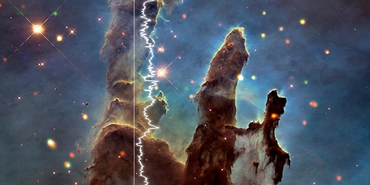
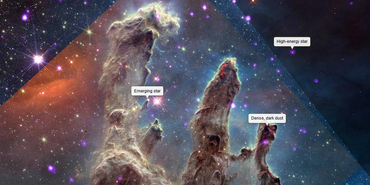
The Pillars of Creation are clouds of gas and dust stretching several light-years within the Eagle Nebula. Their shapes are created by strong stellar winds and high-energy radiation from hot, newly formed stars in star cluster NGC 6611, which lies at the center of the nebula. These high-energy emissions heat the dust molecules on the surface of the pillars and produce eye-catching ionizing flows that outline the clouds.
Within the pillars, astronomers identified various stages of star formation, including embedded protostars (still-forming stars), stellar jets, and even the newborn stars themselves. These relationships and interactions between stars and dust occur in star-forming regions throughout our Milky Way galaxy.
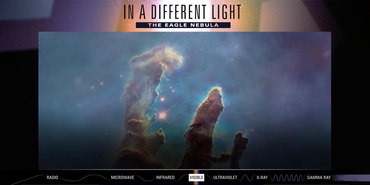
The Pillars of Creation was made famous by the dazzling 1994 Hubble Space Telescope image. However, the pillars, the star cluster NGC 6611, and the surrounding Eagle Nebula have been studied for decades by researchers using many telescopes that observe light across the electromagnetic spectrum.
1995: Hubble Space Telescope first observes the Pillars of Creation in visible light
2005: Hubble Space Telescope observes the Stellar Spire in the Eagle Nebula in visible light
2007: Spitzer Space Telescope observes the Eagle Nebula and Pillars of Creation in infrared light
2011: Hubble Space Telescope observes the star cluster NGC 6611 in near-infrared light
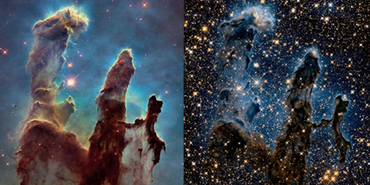
2015: Hubble Space Telescope revisits the Pillars of Creation in visible and near-infrared light
2018: Chandra X-Ray Observatory explores the Pillars of Creation in X-ray
2022: Webb Space Telescope observes the Pillars of Creation in near-infrared light
Learn about the Pillars of Creation
NASA’s Astrophoto Challenge
The Pillars of Creation and the Eagle Nebula was highlighted in a past NASA’s Astrophoto Challenge, but the opportunity to create your own image still exists!
Try your hand at processing images of the Pillars of Creation from NASA’s space telescopes, or capture and process your own.
Learn about the Life and Death of Stars
-
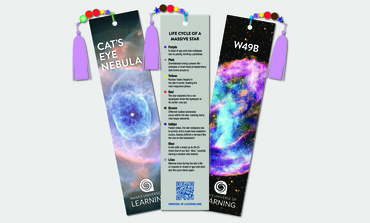
Stellar Life Cycle Bookmark and Bracelet
Participants will learn that the evolution of a star depends on its initial mass. They will create a tassel for a bookmark describing the stages of a star’s life cycle, using different colored beads to represent each stage.
-
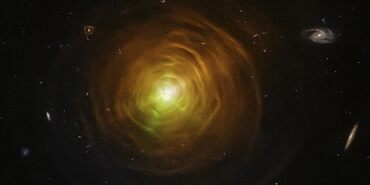
Stellar Evolution Scavenger Hunt
This activity introduces participants to the many stages in the life cycles of massive and low-to-intermediate-mass stars.
-
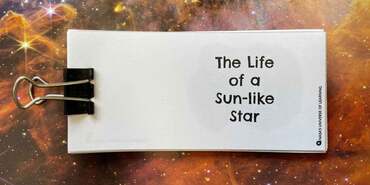
Stellar Evolution Flipbook Activity Guide
Participants will explore the life cycle of a star by creating a small book with a series of pictures that change gradually from page to page.
-
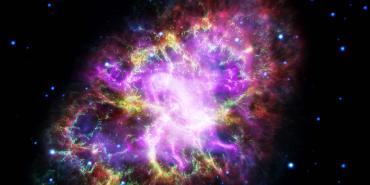
Life and Death of Stars Resource Guide
This resource guide contains a range of resources and activities to help you guide audiences as they explore many facets of stellar evolution!
-
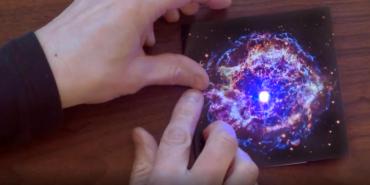
Paper Circuits: Light Up Exploded Stars
Paper circuits help learners of all ages explore the basics of electricity and conductivity. They function as simple low-voltage electronic circuits made using paper, LED lights, a type of conductive tape such as copper, and a small battery for the power source.
-
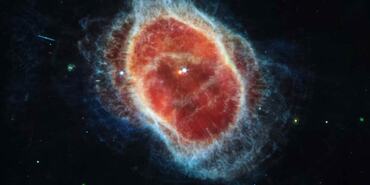
Science Briefing: Exploring the Lives and Deaths of Stars
Learn how low-, intermediate-mass, and massive stars evolve in single- and binary-star configurations.
-
Science Briefing: Deaths and Afterlives of Stars
Learn about the deaths of massive stars and the high-energy remnants of massive stars (pulsars), and how NASA’s high-energy missions provide insight into these processes.
-
Science Briefing: Cosmic Chills: Vampire Stars, Black Widow Pulsars, and Dark Energy
Hear about some of the most terrifying objects in space: vampire stars, black widow pulsars, and dark energy.