
PLANETARIUM ASSETS
Introduction
Hevelius illustrations, immersive visualizations and other resources.
There is an incredible amount to learn about the night sky from cultures around the world! Here, we offer detailed mythological illustrations to layer over constellations, science briefings that provide insights into distinct cultural perspectives, and scientific visualizations that are ready to project on a dome.
Hevelius Illustration Downloads
Humans have carefully cataloged the locations of the stars for thousands of years. These atlases often noted the precise positions and brightnesses of individual stars, and were produced by people across the globe. In the 1600s, Johannes Hevelius spent decades developing, building, using, and writing about telescopes and astronomical tools. He also produced a star atlas, “Firmamentum Sobiescianum sive Uranographia,” which contains finely detailed engravings that represent figures, animals, and objects that trace constellations. These detailed illustration files are available below to use in non-commercial applications. We acknowledge that these illustrations represent only one cultural perspective.

There are several file formats to choose from, along with two viewing angles. Hevelius pictured the celestial sphere as if he was capturing what is seen when looking down on Earth. Illustrations from this perspective are found in the second sets of files.
To make it easier to add these figures to planetarium domes, designers mirrored the illustrations so they appear as if you are staring up at them from Earth. These are found in the first sets of files. Every download offers the complete set of Hevelius illustrations in a specific file type from a single angle. They are all designed to appear in front of a star field of your choosing.
When using these files, please credit the U.S. Naval Observatory and Space Telescope Science Institute.
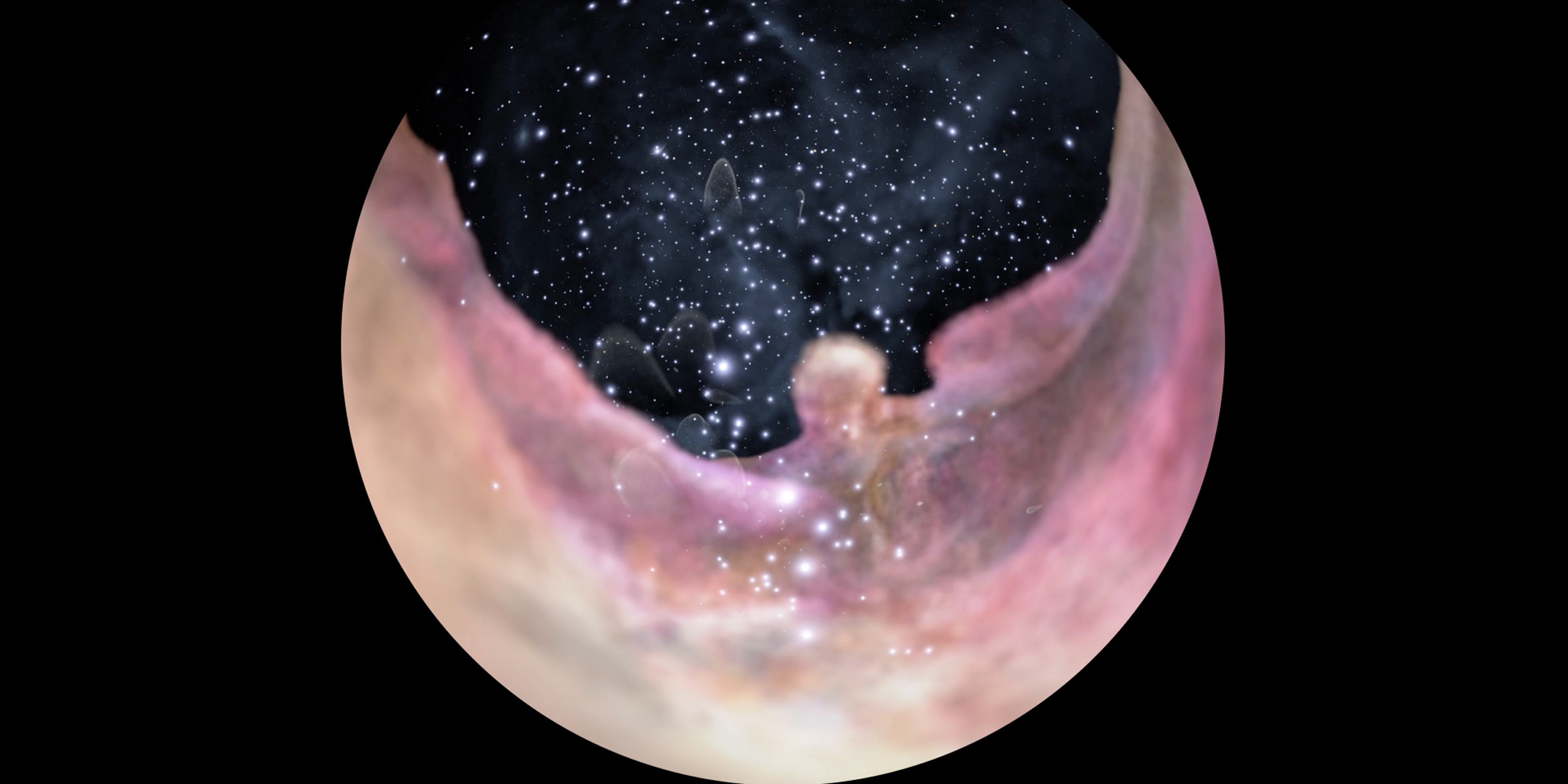
Dome Visualizations
Take visitors on “flights” through the gaseous landscapes and crowded star clusters, “cruise” through the cosmic web, or watch two spiral galaxies on a collision course. Each resource includes frame sets for download.
ViewSpace Resources
Videos
ViewSpace videos tell the stories of the planets, stars, galaxies, and universe, giving viewers the opportunity to experience space and Earth as seen with satellites and telescopes.
The following video provides an overview of ViewSpace’s video resources, including what makes them unique, how to find videos in the Video Library, the benefits of setting up a ViewSpace video kiosk or exhibit, and more.
The ViewSpace Video Library is open to anyone who wants to view individual videos. Our looping Video Collection is specifically designed for exhibits and is available at no cost to organizations such as museums, science centers, and libraries that would like to present ViewSpace to the public.
Interactives
ViewSpace interactives allow you to explore objects and materials from different perspectives, discovering how we can combine information to better understand the universe.
The following video explains how to use ViewSpace’s free Interactives web app, including downloading it to your device, and locking it with Guided Access to prevent users from leaving the app. This is ideal for interactive kiosks, exhibits, or for use during public programs.
ViewSpace interactives are available online for the public.