
About This Article
The goal of NASA's Universe of Learning (UoL) is to connect the public to the data, discoveries, and experts that span NASA’s Astrophysics missions. To make this possible, the NASA's UoL team creates engaging STEM experiences that let people explore data and discoveries from NASA’s Astrophysics missions and learn from the experts behind them.
One example is the Program Facilitator Guides—a series of resources for informal educators that cover different astrophysics themes and empower organizations to share NASA science with their audiences. Since their introduction, these guides have supported libraries and community centers in delivering engaging STEM learning experiences. "The Programming Guide is just amazing … that resource alone is really great for planning. There’s so many opportunities for programs… and there’s room for your own creativity as well," shared one educator.
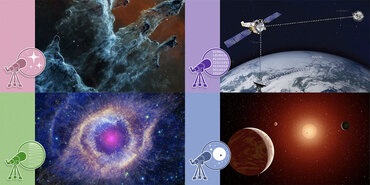
The NASA's UoL team is excited to announce the refresh of several Program Facilitator Guides, along with the introduction of a new guide. These resources have been updated based on feedback from the informal education community, collected through evaluation surveys, focus groups, and webinars. From events held last year before the updates, the guides received a highly favorable rating—91% of educators found them useful as a resource, emphasizing their value in supporting informal STEM education. To make them more effective, we implemented the following updates:
- Easy and direct access to all Program Facilitator Guides through a dedicated web page under the “Informal Educators” menu on NASA’s Universe of Learning.
- Creating an easy-to-access URL for the Program Facilitator Guides: https://universe-of-learning.org/program-guides.
- Making available PowerPoint slides and Kahoot Quizzes for the facilitator to complement the Program Facilitator Guide themes.
- Moving activity guides to a more user-friendly and standard template.
- Designing a set of resources around some of the methods astronomers use to find exoplanets — worlds beyond the solar system — in collaboration with a NASA Science Mission Directorate Community of Practice for Education (SCoPE) grantee:
- The “Finding Exoplanets” Program Facilitator Guide
- The “Lights, Coronagraph, Action!” Activity Guide that demonstrates how astronomers find exoplanets via direct imaging
- The “Exoplanet Detectives” Activity Guide that shows how astronomers find exoplanets by measuring the amount of light that gets blocked when a planet transits its host star.
The new and updated resources are available now through the following URL: https://www.universe-of-learning.org/program-guides.
For any questions or suggestions, please contact:
The NASA’s Universe of Learning team
Email: info@universe-of-learning.org
Website: https://www.universe-of-learning.org/